Monday, January 28, 2013

Santa Anna's Deal

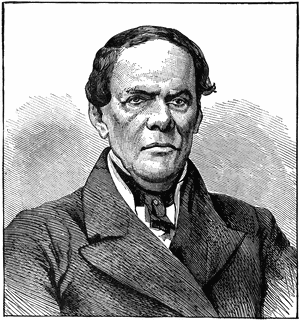
Antonio Lopez de Santa Ana

      From his exile in Havana Cuba, former Mexican President General Santa Anna had been communicating with the United States about the Mexican-American War.  The General insisted that the Mexican government would only cooperate with the U.S. if the U.S. was aggressive during the conflict.   President Polk had sent an envoy to Cuba to negotiate a top secret deal with the Mexican General.

     If the United States guaranteed Santa Anna safe passage back into Mexico, he assured President Polk that he would be able to negotiate a peace with the United States and put and end to the conflict.  Santa Anna also agreed to let the United States obtain the territory of Alto California in exchange for a financial settlement.  Once the two parties had reached an agreement Santa Anna boarded a ship bound for Mexico that could get through the U.S. blockade without being harassed.

    Polk desperately wanted a quick end to the fighting and went as far as to negotiate a deal and his controversial bargain with Santa Anna shows how badly he wanted California.  Polk's desperation would prove to be a bad decision when General Santa Anna goes back on his promise and once he is back in control of Mexico he aggressively continues the fighting against the U.S.

    During the war Santa Anna would view some of his military commanders as potential rivals for power.  During the defense of Mexico City, General Santa Anna refused to assist General Vallencia's forces.  Vallencia's success would threaten Santa Anna's power so while Vallencia's men faced the brunt of an American attack, Santa Anna watched his rival get beaten by his enemy.

   Here is a link to all of the notes on the Mexican-American War.

Tomorrow, the Reading and the Questions are due.

  Here is the link to the History Channel Mexican-American War documentary we watched in class.

Friday, January 25, 2013

The Mexican-American War

      The Mexican-American War lasted from April 25, 1867 to February 2, 1848.  By the end of the conflict the United States suffered 13,283 casualties while Mexico losses are estimated at 25,000.  Mexico would also lose 55% of its territory, roughly 525,000 miles and the United States was now a nation that extended from the Atlantic Ocean to the Pacific Ocean.  Since the war, the United States and Mexico have been on two very distinct paths of fortune, paths that have their roots in the Mexican-American War.

   After your quiz you had the option of choosing between two readings on the Mexican-American War.  By Tuesday your readings should be marked up and the question sheets are to be answered.


Questions for Chapter 8 Reading

Questions for "We Take Nothing by Conquest.." Reading

Wednesday, January 23, 2013

Pop Quiz Tomorrow


  Tomorrow's quiz is 28 questions long and there are 2 omits.  All of the questions come from your notes and handouts in class and I believe that you will all do fine if you take your time and use the resources that you have.

   There are three main topics on the quiz: Manifest Destiny, Texan Revolution/Texas Annexation, and the Missouri Compromise.   If you want to do some last minute organization, I am going to recommend the following.


1. Make a Three Column Chart on Annexation


  Reasons For                                     Reasons Against                                          People For


1.


2.


This will be a quick visual for you to use on the quiz, and would be a good way to practice studying.


2. Streamline Your Notes Section.

 By putting aside your notes on the Mexican-American War and anything else that you do not need you will making your life much easier. The less pages you have to flip through to find an answer will lower your stress level and save you time.


3. Work on some practice questions

   1. Who made the Missouri Compromise?  Why did the U.S. need to find a solution on letting Missouri into the Union?


2.  Henry Clay flip flopped on the issue of Texas?  How did that cost him the election?


3. What were two economic benefits of the U.S. expanding West?


4. Why did Texas rebel against Mexico?


4. Bring in a Snack for the Quiz.


Good luck, and I will see you tomorrow.


Tuesday, January 22, 2013

Polk's Plan


      Congressman John Slidell's mission to Mexico was very complicated and surrounded in mystery.  President Polk had sent Slidell to Mexico to negotiate two different plans.  The American and Mexican public were told that Slidell was to have Mexico agree on the Rio Grande as the border between Mexico and Texas.  Polk also ordered Slidell to offer Mexico $30 million for Alto California and Nuevo Mexico, roughly 50% of Mexico's territory.

     When Slidell and his staff arrived in Mexico City they found themselves in political limbo.  The President of Mexico Jose de Herrera was struggling to remain in power.  Herrera had negotiated peacefully with the United States in the past and because of this many Mexican officials were plotting overthrow him. If Herrera understood that if he  agreed to meet with Slidell it would jeopardize his power.  When word reached Mexico City that General Zachary Taylor had arrived in Texas with 3,550 soldiers, Herrera struggled to hold on to his office.

    News of Slidell's $30 million offer came out and caused a public outcry in Mexico.  Manu Mexicans saw the American offer as an insult and felt that the the intentions of the U.S. were clear: California was their goal. President Herrera was overthrown by General Mariano Paredes the commander of the Mexican army.   Slidell and his staff returned to the United States, where Slidell advised the President that it would be necessary to use force in order to get Mexico to negotiate peacefully.

    On March 3, 1846, General Zachary Taylor's forces arrived on the northern banks of the Rio Grande overlooking the Mexican town of Matamoros.  Taylor's men began to construct a fort along the river and began to prepare for a long siege.  From the other side of the Rio Grande, the residents of Matamoros observed as the Americans aimed their artillery at their town.  Taylor refused to meet with the commander of the Mexican army at Matamoros and ordered scouting missions along the river bank.

     After the disappearance of two U.S. soldiers, General Taylor increased the number of patrols in the area. On April 25, 1846, 1,600 Mexican calvary division attacked 63 U.S. soldiers on a patrol.  The fighting lasted a few minutes and ended with the deaths of 11 U.S. troops, six wounded,  with the rest taken captive.  When word reached General Taylor of the fight, he sent a message to President Polk that hostilities had occurred and that U.S. soldiers had died on American soil.

     Polk now had the justifiable reason to ask Congress for a declaration of war.


Friday, January 18, 2013

James K. Polk and the Election of 1844


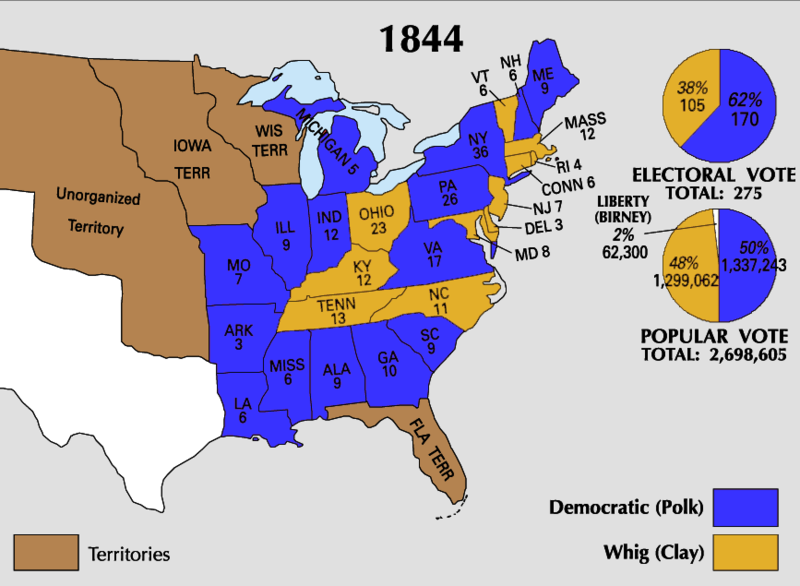
        "Who is James K. Polk?", that was the brash slogan of the Whig Party during the election of 1844.  The Whig candidate for President, Henry Clay, was favored to defeat the relatively unknown James K. Polk in the election.

       Henry Clay had an outstanding resume for a Presidential candidate.  Prior to 1844, Clay had held the following positions in government: Congressmen, Senator, Speaker of the House, and Secretary of State.  Clay was famous in the both the North and South for helping to create the Missouri Compromise and had been a Presidential candidate in the past.  1844 seemed like Clay would finally achieve his dream of becoming President until he misspoke about the issue of Texas.

     Clay had originally campaigned that if he was President he would veto any bill that would admit Texas into the Union. This secured his support in many of the Northern states that saw Texas as a means of extending slavery.  Late in the campaign, Clay went back on his word, and said that he would support  the annexation of Texas.  His flip-flopping on Texas alienated many of his supporters and gave Polk the advantage.

    Outside of Tennessee and the House of Representatives few Americans had heard of James K. Polk.  Polk was a hardworking lawyer and a successful politician in his home state.  His father was close friends with Andrew Jackson, and Jackson would serve as Polk's political role model and mentor.  He was elected to be Speaker of the House by his fellow Congressmen in 1835 and served until 1839.  when he was elected  the governor of Tennessee.   Polk arrived at the Democratic Convention hoping to get the nomination for Vice-President but after 8 rounds of  balloting he would become the Presidential nomination.

      James K. Polk aggressively campaigned on a platform that had four main goals: Annex Texas, Acquire California from Mexico, Secure the border between Oregon and Canada, and a Lower Tariff.  Polk combined the issues of Oregon and Texas to avoid further discussion of slavery.  Polk's policies made him appealing to Northerners and Southerners who believed in American expansion.

     The election was very close with Polk doing well in the West and South with Clay winning most of the Northeast.  Polk won  the crucial state of New York by just over 5,000 votes to secure him the victory, had Clay won New York he would have won the election.

File:1844 Electoral Map.png


Due Wednesday: Manifest Destiny Study Guide. 

Wednesday, January 16, 2013

Annexation of Texas


         In 1836, the Republic of Texas sent officials to Washington D.C. with a request.  They wanted the United States to annex Texas and have it become part of the U.S.  Although Andrew Jackson sympathized with the people of Texas, he refused to admit Texas into the Union out of fear that it would start a war with Mexico.  Many Texans were upset that the U.S. refused their request and hoped that they would one day become part of the Union.

        In 1837, the people of Texas elected Mirabeau Lamar to be the new President of Texas.  Lamar believed that Texas should remain an independent nation on not depend on the United States to come to  its rescue.  He sent officials to Great Britain, France, and Belgium and got those nations to fully recognize the independence of Texas.  Lamar withdrew Texas's request for statehood and focused on improving the Texan economy.  Despite Lamar's position on annexation, many in Texas believed that becoming part of the U.S. was key to Texas's future.

       In 1843, U.S. President John Tyler was faced with the political fight of his life.  Members of his own party were openly discussing nominating another person to run for President in 1844.  Tyler needed to do something to boost up his popularity and he saw Texas as an answer.  Tyler sent Andrew Jackson Donelson (President Jackson's nephew) to go to Texas to work on an annexation deal that would bring Texas into the Union.  Donelson reported back to the President that annexation would be supported by the people of Texas but there was a concern as to how Mexico would respond to the annexation.

      In the spring of 1844, Secretary of State John C. Calhoun wrote a letter to the British Ambassador to the United States asking for British support regarding Texas.  In the letter Calhoun explained that the annexation of Texas was key to ensuring the survival of slavery in the United States. When Calhoun's letter was leaked to the press it created an uproar in the North.

    Some Northern groups claimed that if Texas became a state then the balance of power in Congress would now belong to slave states and would further spread slavery across the country.  Many Northerners saw the annexation of Texas as illegal and unconstitutional.  Some critics of annexation claimed that Texas was too big to become a state, and by admitting Texas into the Union it would weaken the federal government.  Others felt that if the U.S. granted Texas statehood that it would lead to a war with Mexico.


Tuesday, January 15, 2013

The Texan Revolution


   In 1821, the people of Mexico won their independence from Spain after almost 300 years of colonial rule.  The Mexico controlled a vast portion of North America, and the new government struggled with finding a successful way to manage it. 

        The Mexican government was particularly concerned with the territory of Texas.  Rich in natural resources and over 500 miles from the Mexican capital, Texas seemed like the ideal target for another nation.  Due to the fear of the Comanche, Texas was a sparsely populated part of Mexico that had potential to help bring the new nation out of debt.  Mexico began to offer incentives for Mexican citizens to relocate to Texas hoping to make it more populated and harder to take over but many Mexican citizens chose not to relocate to Texas.

    An American named Moses Austin traveled to Texas in 1821 to negotiate a settlement that would allow him to establish an American community in Texas. Austin died before he could lead his expedition, but his son Stephen Austin took over the planning.

      The Mexican government agreed to allow American settlers move to Texas if they obeyed the following rules:

           1. Settlers were to become Mexican citizens and obey all Mexican laws.

            2. Texan settlers were to convert to Catholicism and expected to assimilate to Mexican culture.

            3. Settlers were to pay taxes to the Mexican government.

Austin was assured by  Mexican officials that the American settlers would be able to live tax free and maintain their slaves for one year.  In 1825, Austin led 300 families into Texas to establish a new settlement near the Bravos River.

      Gradually more and more settlers from the United States moved to Texas, many of them living outside of Austin's settlement.  As the American population of Texas began to grow an increase in tensions between the Texan settlers and Mexican government began to grow.  Mexican officials complained that the Texans were not obeying Mexican law and refusing to assimilate to the Mexican culture.  The growing slave population of Texas was a clear indication that the Texans were not honoring their contract with Mexico.  When the  Mexican President passed a law that made it illegal for any more Americans to move into Texas, fighting and protests broke out across Texas.

    Many Texan settlers felt that the government of Mexico was taking away their basic rights and freedom.  Some Texans compared themselves to the American colonists who were protesting the taxes and policies of Great Britain before the American Revolution.  While Stephen Austin worked to resolve the growing crisis, some Texans began to call for Texas to break away from Mexico.

     In October of 1835, the people of Gonzales fought the first battle of the Texan Revolution.  That November, Texas declared itself independent from Mexico and began to seek assistance in order to win  its freedom.


Texan Revolution Notes

Tonight's H.W. is to Read and Markup the Tyler and Texas Reading and to answer the 3 questions on the first. page.